
Marketing automation is cloud-based software that helps you turn leads into customers and nurture customers into buying more of your products or services, more often. It does this through automated campaigns, primarily email, that you can integrate with postcards, letters, and text and voice messaging. In short, it's technology that lifts your marketing results while saving your organization manpower, time, and money.
From Email to Marketing Automation
Since the 1990s, email has been a standard way to communicate with contacts. Compared to traditional direct marketing like direct mail or print advertising, email costs less and can drive a higher response rate, making it cost-efficient with a strong ROI, and easy to measure.
As a standalone tool, email is efficient and great for promoting a product for a quick sale. But when email becomes a key part of a larger sales and marketing campaign, you need more than a way to send and receive messages. You need a platform that customizes the campaign and the message for each contact. That's where marketing automation comes in.
Marketing automation integrates your email strategy with the rest of your marketing to produce better results.
The Buying Process
Marketing automation gives you insight into your customers' buying behavior so you can capitalize on opportunities to drive purchases. It starts with understanding the buying process.

Every buyer moves through a process that starts with awareness. Your goal is to guide them to a purchase, and once they buy, to buy again and refer others to you.
Marketing automation works by sending a series of messages based on what you know about each contact and where they are in the buying process. Different contacts are at different stages, so each gets a different message. The higher the price or the more decision-makers involved, the longer the process, and automation keeps it moving toward the sale.
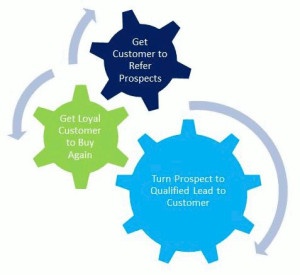 It's not only about sending messages, though. It's also about collecting information from each contact and adding it to your database, so you can tell where each person is in the buying journey.
Marketing automation can help you:
- Turn prospects (qualified leads) into customers
- Get customers to buy again sooner, more often, and in bigger amounts
- Encourage customers to refer their contacts to you
What Does Marketing Automation Look Like?
Marketing automation integrates technology with data, information about your contacts, content about your products and industry, and the channels you use to communicate. You program what data to use, what content to share, and how and when to send it.
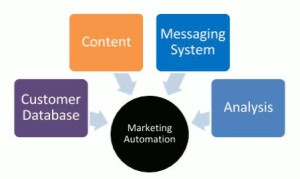
Your system can identify which stage of the buying process a contact is in and, with the right message at the right time, guide them to the next stage. For some contacts that's one or two emails; for others it's a longer mix of emails, texts, voice messages, and postcards. Instead of blasting the same single email to everyone, you build a series of messages and let the system deliver the right content to the right contact. You pre-program and store everything (email copy, direct mail, text and voice messages, PDF reports, and landing pages) and use the system's analytics to measure results.
Example #1: A Simple Campaign
Here's a small, simple automated campaign:
- A visitor opts in to your email in response to a free-report offer.
- Your system sends each new contact a series of automated emails.
- The first is a thank-you with a link to download the report.
- The rest send automatically at times you've scheduled; you decide how many and what each one says.
- Each email can link to a landing page that sells a product or service they can buy online.
Example #2: A Bigger Campaign
Here's what a larger campaign might look like, with separate auto-responder series that integrate with your database but run on different timelines:
- Start with the steps above, then continue with the following.
- Send a series of auto-responders. Some include a short survey about the contact's company and likely problems (stored in their record); others invite them to a webinar.
- Based on the survey answers, the system automatically sends the most relevant case study, whitepaper, or educational content.
- For contacts who register for the webinar, send a series of email, text, and voicemail reminders.
- Somewhere along the way, the contact buys the product from your landing page.
- After the purchase, a series of emails goes out with order confirmation, shipping info, and a survey about the experience.
- A few weeks later, an email requests product feedback and links to your social media for a testimonial.
- Ongoing emails (every few weeks) introduce other products, encourage reorders of consumables, and ask for referrals.
- Finally, the system can send a postcard or text about a special promotion and analyze the responses in real time.
Marketing Automation Is Ideal for Many Types of Companies
Before computers, what a simple automated system does today would have taken people days or weeks. Now that it integrates with your website, social media, email, text, and voice, marketing automation can help a small business punch like a much larger one. It's especially ideal for companies that have:
- A long buying process
- A growing contact database with a wide demographic or psychographic range
- A need for multi-touch campaigns across email, text, voice, and print
- A small marketing budget and few salespeople, but a need for a steady, growing flow of qualified leads, reorders, and referrals
- A website that's a key sales driver, especially with e-commerce
- A preference for making decisions based on data and ROI analysis
The Realistic Pros and Cons of Marketing Automation
Now that you know the basics, you might wonder if it's too good to be true. Mostly, no, but it does take work.
Like Amazon, you can use marketing automation to nurture prospects with highly personalized content. Set up and managed well, with strong content behind it, it converts prospects into customers and customers into bigger buyers, driving revenue, loyalty, and brand equity with a high ROI.
But as HubSpot has long pointed out, marketing automation isn't effortless. The tools are all there, but you still have to think hard about your campaign and how the moving parts fit and schedule together.
The component that makes or breaks results is persuasive content, a skillset your team may not have or have time for, which is often worth outsourcing. The other risk is neglect: you have to manage the system regularly, especially when running many processes at once.
And no matter how well you plan, one thing still determines success: the number and quality of your leads. Automation can do nearly everything except get the lead to your site to opt in. Some companies buy leads, but HubSpot has compared that to adding artificial ingredients to grow your business.
The better path is generating your own leads with programs that attract the right prospects, like SEO, search advertising, business listings, PR, and blogging. Leads you earn organically tend to build longer customer relationships than purchased lists, and a steady lead-generation strategy also offsets the customers any business loses over time.
Once you're generating leads, use a multi-channel approach. Email is at the heart of marketing automation, but don't rely on it alone; postcards, text, voice, and even telemarketing can boost results. And whatever you send, make sure it's genuinely valuable; even loyal customers tune out (or unsubscribe) when the emails stop being relevant.
Today's Marketing Automation Platforms
The good news is that the tools have matured, with options for nearly every budget and need. Popular platforms include HubSpot, Marketo (now part of Adobe), Salesforce Marketing Cloud and Account Engagement, ActiveCampaign, Mailchimp, Brevo, and Klaviyo (a favorite for e-commerce). Most now build in AI as well, predictive send-time optimization, automated segmentation, and AI-assisted content and subject lines, which makes sophisticated, personalized campaigns easier to run than ever. The right platform depends on your size, your budget, and whether you need tight CRM, e-commerce, or sales integration.
Next Steps
Marketing automation is a vital tool for developing customers and boosting sales. Paired with a well-planned lead-generation strategy, it can give you a real competitive advantage and a far higher ROI than batch-and-blast email. That's why it belongs near the top of your marketing to-do list.
If you'd like help choosing a platform and building campaigns that actually convert, get in touch with our team.


0 Comments