
Google has spent more than a decade reshaping search to understand the world the way people do, and it started with the Knowledge Graph.
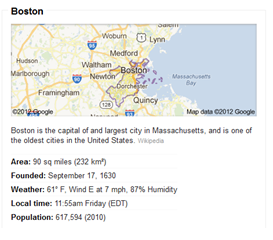 Back in 2012, Google introduced the Knowledge Graph with a now-famous phrase: "things, not strings." Instead of just matching the letters you typed against pages on the web, Google began understanding the real-world things behind your words, people, places, companies, concepts, and how they relate to one another. More than a decade later, that idea has become the backbone of search and the AI features built on top of it. Optimizing for it has a name: entity SEO.
From Keywords to Entities
An entity is any distinct "thing" Google recognizes and stores in its Knowledge Graph: a person, a place, a business, a product, an idea. The classic example is a search for "Boston." Google knows Boston is a city (and shows a map, a summary, and key facts), but it also knows Boston is a band, and can offer that as a separate result. It's distinguishing between two different entities that share the same name, something keyword matching alone could never do reliably.
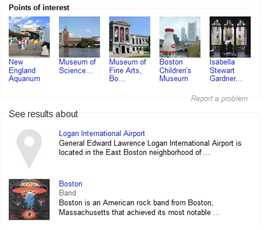 That's the heart of the shift. As Google put it when it launched the Knowledge Graph:
This is a critical first step towards building the next generation of search, which taps into the collective intelligence of the web and understands the world a bit more like people do.
For SEO, this means search is no longer only about the words on your page. It's about whether Google understands what (and who) your business is, what you're an authority on, and how you connect to the other entities in your space.
What Is Entity SEO?
Entity SEO is the practice of helping search engines clearly recognize and understand your brand, your people, and your topics as distinct, trustworthy entities, rather than just hoping your pages rank for the right strings of text. The goal is for Google to know your business is a real, well-defined "thing," with a clear identity and credible connections, so it can confidently surface and cite you.
Why Entities Matter More Than Ever
This used to be a nice-to-have. Now it's central, for two reasons:
- AI search runs on entities. Google's AI Overviews and AI Mode are powered by models trained on the Knowledge Graph. If your brand is a well-established entity that Google understands and trusts, you have a structural advantage in being cited in those AI answers. If you're not in the graph, you're largely invisible to them.
- Knowledge Panels and brand presence. The information box that can appear when someone searches your business, the Knowledge Panel, is generated from your entity data. A strong entity presence shapes what Google shows about you and helps you own more of the results page.
How to Strengthen Your Entity Presence
You can actively help Google understand your business as an entity:
- Add Organization structured data. Mark up your homepage with Organization schema (JSON-LD), including your name, logo, URL, and a
sameAslist that links to your official profiles (social media, and a Wikidata or Wikipedia page if you have one). This is the clearest way to tell Google exactly who you are. - Create a clear "entity home." Pick one authoritative page, usually your About page, that defines your business plainly and consistently: who you are, what you do, where, and how long you've been doing it. This becomes the anchor Google uses to understand your brand.
- Claim and complete your Google Business Profile. For local businesses especially, your Google Business Profile is a key entity signal, tying your name, location, and category together in Google's own data.
- Keep your information consistent everywhere. Your business name, description, and details should match across your site, social profiles, directories, and listings. Conflicting information makes Google less confident about your entity.
- Build genuine authority. Mentions and links from reputable, relevant sites, plus clear demonstrations of expertise, all reinforce that your entity is trustworthy, which is exactly what Google's E-E-A-T guidance rewards.
- Be precise on every page. Make each page unambiguously about one topic, with the title, heading, and content all pointing to the same idea, so Google can connect it cleanly to the right entity.
The Payoff
Google has become a one-stop place for information, and it now answers many questions directly in search and in AI, which can cut into clicks for generic information. But for businesses, being a recognized, trusted entity is how you stay visible in that world: showing up in Knowledge Panels, earning citations in AI answers, and being the brand Google associates with your space.
Want help building your brand's presence in search and AI? See how our SEO team can help, or get in touch to talk it through.
This is part of our guide to marketing your small business online.


0 Comments